

- Reconnaissance (Recon) accounts for over 70% of high-severity bounty discoveries on HackerOne and Bugcrowd.
- Mastering Go-based CLI utilities like Subfinder, httpx, and Katana enables automated asset discovery faster than manual inspection.
- Nuclei templates allow rapid detection of known CVEs, misconfigurations, and exposed admin panels within minutes of release.
- Deep manual testing with Burp Suite remains irreplaceable for discovering complex business logic flaws and IDORs.
- MNA Tech Academy in Jaipur provides dedicated private lab environments where students practice live ethical hacking legally.
1. The Bug Bounty Landscape in 2026: Why Tooling Matters
Bug bounty hunting has evolved into a multi-million-dollar global industry. Companies like Apple, Google, Microsoft, Uber, and hundreds of Indian startups pay independent security researchers to legally discover and report security vulnerabilities before malicious hackers can exploit them.
However, competition is fierce. When a new public bug bounty program launches, hundreds of security researchers scan the main domain within the first hour. Finding high-severity vulnerabilities (P1/P2) that pay $1,000 to $10,000+ requires specialized reconnaissance tools, automated fuzzing pipelines, and deep manual logic testing.
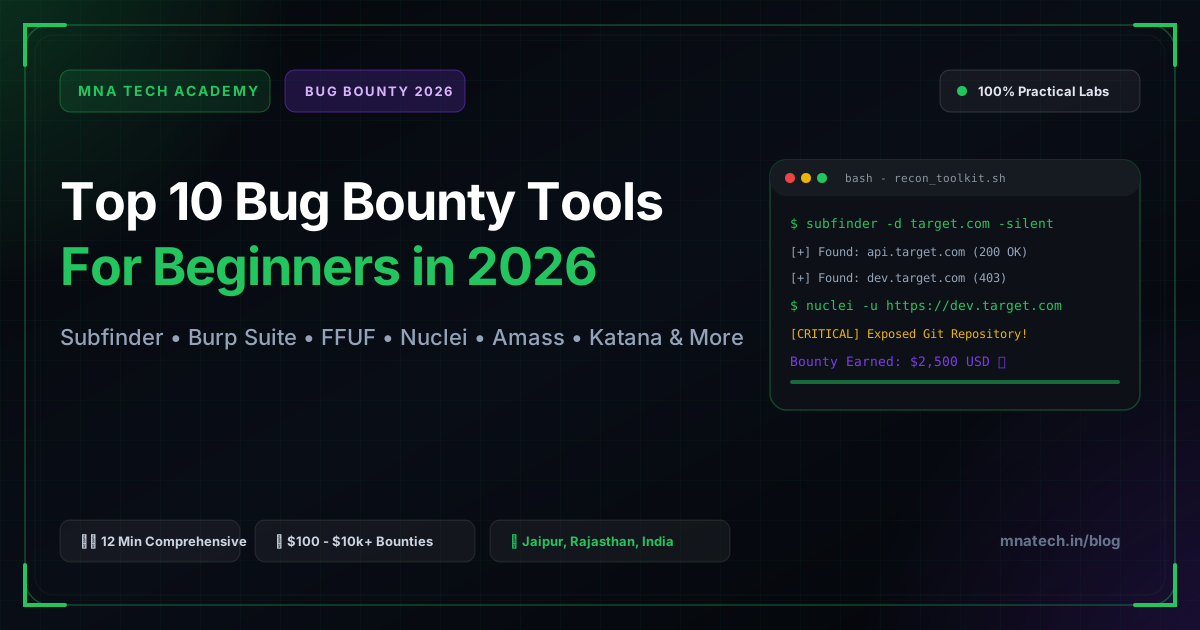
Below is the definitive, battle-tested breakdown of the Top 10 free and open-source tools that every beginner must master in 2026.
Core Hunting Rule
Never scan or attack any target without verifying that it is within the program's official scope on platforms like HackerOne, Bugcrowd, or Intigriti. Always adhere strictly to responsible disclosure guidelines.
2. Subfinder — High-Speed Passive Subdomain Enumeration
Developed by ProjectDiscovery, Subfinder is the undisputed industry standard for passive subdomain enumeration. Unlike brute-force tools that spam DNS servers, Subfinder passively queries over 40 public search engines, DNS databases, SSL certificate transparency logs (crt.sh), and ThreatCrowd.
Why Beginners Need It: It runs passively without sending direct traffic to the target company, meaning your IP will never get blocked while discovering forgotten development, staging, and API subdomains.
Pro Hunting Tip
Configure free API keys in ~/.config/subfinder/provider-config.yaml (SecurityTrails, Censys, Shodan, VirusTotal) to increase discovered subdomains by 300%.
# Installation via Go:
go install -v github.com/projectdiscovery/subfinder/v2/cmd/subfinder@latest

# Command syntax for clean output:
subfinder -d example.com -silent -all -o subdomains.txt
3. OWASP Amass — Deep Network Mapping & OSINT Engine
While Subfinder focuses on pure speed, OWASP Amass focuses on exhaustive depth. Amass correlates WHOIS data, Autonomous System Numbers (ASN), reverse DNS lookups, IP ranges, and certificate permutations to map an entire enterprise attack perimeter.
Use Case in 2026: Finding corporate acquisition domains, subsidiary IP ranges, and obscure cloud assets that competitors have overlooked.
# Run Amass passive enumeration on ASN or Domain:
amass enum -passive -d target.com -o amass_subs.txt

# Combine with Subfinder for maximum coverage:
cat subdomains.txt amass_subs.txt | sort -u > all_unique_subs.txt
4. httpx — Lightning-Fast HTTP Prober & Fingerprinting
Once you have a list of 5,000 subdomains, you need to know which ones actually host live web servers and what technologies they run. Attempting to open each in a web browser is impossible.
httpx tests thousands of subdomains per minute, capturing HTTP status codes (200, 301, 403, 500), page titles, server technology headers, SSL certificate expiry dates, and IP locations.
# Installation:
go install -v github.com/projectdiscovery/httpx/cmd/httpx@latest

# Probe live hosts with technology detection and status code:
cat all_unique_subs.txt | httpx -silent -status-code -title -tech-detect -threads 50 -o live_hosts.txt
5. Katana — Next-Gen Web Crawler & JavaScript Spider
Modern web applications are built on React, Angular, Vue, and Next.js. Standard HTML crawlers miss 90% of dynamic endpoints hidden inside compiled JavaScript bundles (.js files).
Katana crawls websites, executes headless browser scripts, and parses JavaScript files to discover secret API endpoints, GraphQL queries, hidden file paths, and administrative parameters.
Bounty Secret
Search crawled .js files for sensitive API keys, AWS credentials, and internal staging URLs using simple grep commands: grep -iE 'api_key|token|auth' endpoints.txt
# Installation:
go install github.com/projectdiscovery/katana/cmd/katana@latest

# Deep crawl with JavaScript parsing:
katana -u https://target.com -depth 3 -js-crawl -o crawled_endpoints.txt
6. FFUF (Fast Fuzzing) — High-Performance Directory & Parameter Fuzzer
Written in pure Go, FFUF is the fastest web fuzzer available today. It tests web directories, exposed configuration files (.env, .git, .backup, web.config), and hidden GET/POST parameters at thousands of requests per second.
Why It Pays Big Bounties: Misconfigured development files like .git/HEAD or database backups (db.sql.gz) accidentally left in web roots frequently lead to instant P1 Critical bounty payouts ($2,000 to $5,000).
# Install FFUF:
go install github.com/ffuf/ffuf/v2@latest

# Directory fuzzing with SecLists wordlist:
ffuf -u https://target.com/FUZZ -w /usr/share/seclists/Discovery/Web-Content/raft-medium-directories.txt -mc 200,301,302,403
7. Burp Suite (Community / Professional) — The Core Interception Proxy
Automated tools find low-hanging fruit, but manual vulnerability assessment with PortSwigger Burp Suite is where 80% of total bounty money is earned. Burp Suite sits between your browser and the web server, allowing you to intercept, inspect, and tamper with HTTP/HTTPS traffic.
Core Features for Hunters:
- Burp Repeater: Manually resend and modify requests to test for Insecure Direct Object References (IDOR) and broken access control.
- Burp Intruder: Automate custom payload brute-forcing and rate-limiting bypasses.
- Logger++ & Turbo Intruder: Power extensions for analyzing thousands of background API requests effortlessly.
Recommended Burp Extensions
Install Autorize (for automated authorization testing), Param Miner (for hidden parameter discovery), and Turbo Intruder from the BApp Store.
8. Nuclei — Rapid Template-Based Vulnerability Scanner
Nuclei revolutionized security auditing with its open-source community vulnerability templates written in simple YAML. Whenever a new critical CVE is published (such as Log4j, Spring4Shell, or Ivanti VPN exploits), the community releases a Nuclei template within hours.
Beginners can run targeted templates across an entire asset list to detect vulnerable packages, misconfigured CORS headers, default admin credentials, and unauthenticated panels.
# Install Nuclei:
go install -v github.com/projectdiscovery/nuclei/v3/cmd/nuclei@latest

# Update community templates and scan targets:
nuclei -update-templates
nuclei -l live_hosts.txt -severity critical,high -o nuclei_results.txt
9. SQLmap — Automated SQL Injection & Database Triage
SQL Injection (SQLi) remains one of the most critical vulnerabilities (OWASP Top 10: Injection). When manual testing suggests an input parameter interacts with a database, SQLmap automates the detection, exploitation, and fingerprinting of database management systems.
In ethical bug bounty reporting, never extract entire private customer databases. Simply use SQLmap with --current-user or --banner to prove the vulnerability exists without causing disruption.
# Test parameter for SQL Injection ethically:
sqlmap -u "https://target.com/api/products?id=10" --batch --banner
10. Kiterunner — Modern API Routing & Microservice Discovery
Traditional web applications used simple HTML forms, but modern cloud architectures use microservices and RESTful/GraphQL APIs. Traditional wordlists fail on API routes like /api/v2/users/auth/refresh.
Kiterunner (built by Assetnote) utilizes wordlists compiled from real-world API datasets (Swagger, OpenAPI, RAML) to brute-force complex nested endpoints and unauthenticated microservices.
# Scan target for hidden API routes:
kr scan https://api.target.com -w routes-large.kite.tar.gz -x 10
11. The Complete Automated Hunting Pipeline (One-Liner Recon Bash Script)
Top hunters chain these individual tools into an automated reconnaissance pipeline. Here is the exact bash workflow taught in practical labs at MNA Tech Academy:
#!/bin/bash
TARGET=$1
echo "[+] Starting Recon on: $TARGET"

# 1. Enumerate subdomains
subfinder -d $TARGET -silent > subs.txt

# 2. Filter live HTTP/HTTPS servers
cat subs.txt | httpx -silent -status-code -title > live_hosts.txt

# 3. Scan for critical misconfigurations and CVEs
nuclei -l live_hosts.txt -t cves/ -severity critical,high -o bugs.txt

echo "[✓] Recon Complete! Review bugs.txt for findings."
12. How to Report Vulnerabilities and Earn High Bounties on HackerOne
Finding the vulnerability is only half the battle. If your bug report is vague or confusing, program triage teams may close it as Informative or Duplicate.
A Professional Bug Bounty Report Must Include:
- Summary: Clear explanation of the flaw and vulnerable endpoint.
- Severity: CVSS 3.1 rating explaining confidentiality, integrity, and availability impact.
- Step-by-Step Proof of Concept (PoC): Reproducible curl commands or HTTP request/response text.
- Impact Statement: Realistic worst-case business risk (e.g. Account Takeover, PII data leakage).
- Remediation: Practical developer recommendations on how to patch the flaw.
Related Search Topics & Keywords (28)
Google Search queries and technical concepts covered in this guide:
Frequently Asked Questions
Can complete beginners start bug bounty hunting without a computer science degree?
Yes! Bug bounty programs are 100% merit-based. Nobody asks for your degree or age on HackerOne, Bugcrowd, or Intigriti. If you report a valid, reproducible security vulnerability, you receive the cash reward and Hall of Fame recognition.
How much money can an ethical hacker earn from bug bounties in India?
Earnings vary depending on skill. Beginners typically earn between ₹10,000 to ₹50,000 per valid medium bug. Experienced penetration testers in India regularly earn $2,000 to $15,000+ (₹1.5 Lakh to ₹12 Lakh+) per month hunting high and critical severity flaws.
Which operating system is best for bug bounty hunting?
Kali Linux and Parrot Security OS are the industry standards because they come pre-installed with penetration testing dependencies. Alternatively, Ubuntu or macOS with Go, Python, and Docker installed works exceptionally well.
What are the most common vulnerabilities for beginners to target?
Beginners have the highest success rates targeting IDOR (Insecure Direct Object References), Information Disclosure (.git, .env files exposed), Cross-Site Scripting (XSS), Sensitive Data in JavaScript files, and CSRF.
Is bug bounty hunting legal in India?
Yes, bug bounty hunting is completely legal provided you test only organizations that have public responsible disclosure or bug bounty programs, test strictly within defined scope, and do not destroy or leak user data.
What tools are strictly prohibited in bug bounty programs?
Denial of Service (DoS/DDoS) tools, brute-force spam tools that crash production databases, and automated social engineering/phishing against company employees are strictly banned across almost all programs.
How long does it typically take to find your first paid bug?
With structured daily practice and hands-on lab training, most dedicated students find their first valid bug within 2 to 3 months of consistent hunting.
Does MNA Tech Academy provide hands-on lab training for bug bounty hunting in Jaipur?
Yes! MNA Tech Academy in Jaipur provides dedicated offline cyber ranges and live VAPT target environments where students learn tool automation, manual proxy testing, and report writing with direct mentor guidance.
Ready to Master Bug Bounty?
Master web application security testing, OWASP Top 10 vulnerabilities, live bug hunting techniques, and 100% placement mentorship.